
The Science of Food Addiction and the Weight of Obesity
Fanelesibonge Zondo | Registered Dietitian

Wednesday, 4 March 2026, marked World Obesity Day—a time when health conversations typically revolve around calorie deficits, exercise, and lifestyle choices. Yet, while these factors are undeniably important, modern science suggests that the reality of obesity is far more complex.
A growing body of research in neuroscience and nutrition asks an important question:
1. What if some foods are designed in ways that make them unusually difficult to resist?
For decades, overeating was largely framed as a failure of willpower. But emerging evidence suggests that the struggle many people face may not be with food in general, but with a specific category known as ultra-processed foods (UPFs). These foods can interact with the brain’s reward systems in ways that resemble addictive substances.
Understanding this dynamic may change how we approach both cravings and obesity.
The Brain’s Reward System and the Dopamine Loop
Our brains are wired to seek pleasure and survival. When we eat something enjoyable, the brain releases dopamine, a neurotransmitter associated with motivation, reward, and reinforcement.
Certain food combinations—especially those rich in fat, sugar, and salt—activate this reward system very strongly.
Research suggests these foods may produce three key effects:
1. Dopamine spikes
Highly palatable foods elicit large dopamine releases, creating a powerful sense of pleasure and reinforcement.
2. Tolerance development
Over time, the brain may require greater quantities of the same food to achieve the same rewarding sensation.
3. Withdrawal-like responses
When these foods are suddenly reduced or eliminated, some individuals report symptoms such as irritability, headaches, or intense cravings.
While food is not identical to drugs in its effects, the behavioural and neurological patterns can share similarities, particularly in environments where these foods are abundant and aggressively marketed.
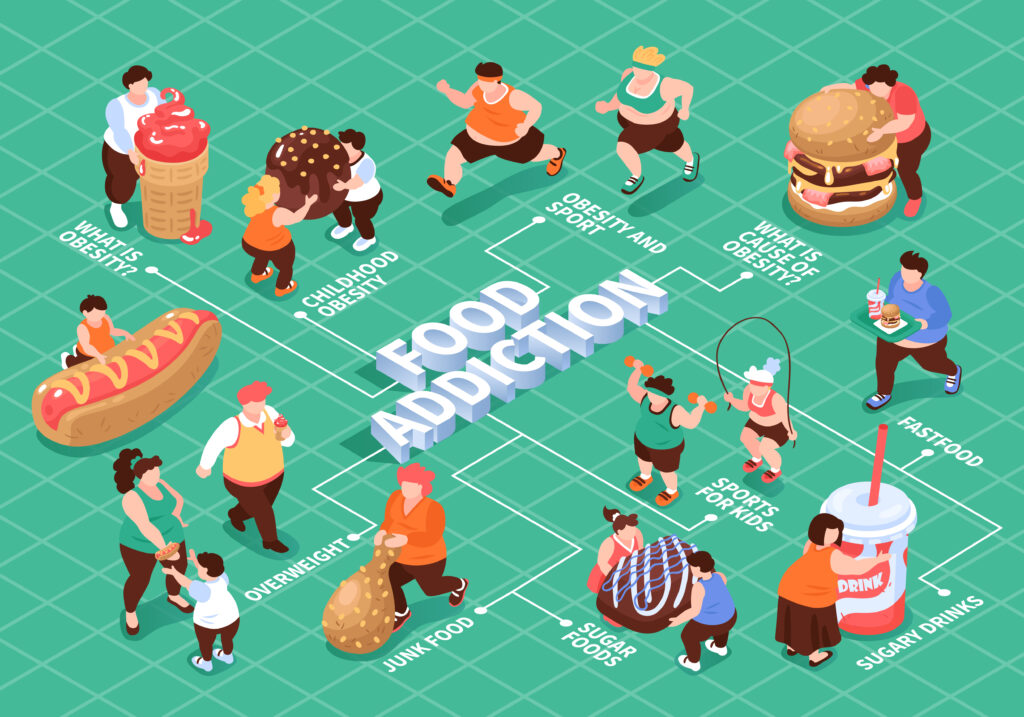
Designed by macrovector / Freepik
What This Means for Obesity
If certain foods can influence the brain in ways that intensify cravings, our understanding of obesity must evolve.
Moving Beyond “Just Eat Less”
Advising someone to simply “eat less” may overlook the biological mechanisms driving cravings. If highly engineered foods stimulate powerful reward pathways, reducing consumption may require more structured strategies than willpower alone.
Recognising the Food Environment
Modern societies are often described as “obesogenic environments.” Energy-dense, highly palatable foods are inexpensive, widely available, and heavily marketed. This constant exposure can make moderation far more challenging.
Understanding this environment helps shift the conversation from personal blame to systemic awareness.
Integrating Mental and Behavioural Health
Obesity is not purely a metabolic condition. Psychological, emotional, and environmental factors also play important roles. Recognising the role of cravings and reward systems can encourage more compassionate and effective support strategies.
The Role of Nutrition Professionals
For many individuals, managing cravings requires more than generic diet advice. Nutrition professionals can help translate science into practical strategies.
A dietitian may focus on several areas:
Behavioural mapping
Identifying specific trigger foods and understanding the emotional or situational cues that lead to overeating.
Metabolic stabilisation
Developing nutrient-dense meal structures that help stabilise blood glucose levels, reducing extreme hunger and energy fluctuations.
Supportive guidance
Moving the conversation away from restrictive dieting toward sustainable behaviour change and food awareness.
With structured support, the journey shifts from a personal battle of willpower to a science-guided approach to eating behaviour.
Understanding the Root of Cravings
Recognising the biology behind cravings does not remove personal responsibility. Instead, it provides a clearer understanding of why some foods feel harder to control than others.
By acknowledging these mechanisms, we can move toward solutions that combine nutrition science, behavioural insight, and supportive environments.
In the next article in this series, we explore the foods most commonly associated with these powerful cravings: ultra-processed foods, how they are engineered, and why they are so easy to overconsume.
References:
- Atar A. Neurobiological Consequences of High-Fat High-Sugar Diets on the Mesocorticolimbic System: a Narrative Review. Curr Nutr Rep. 2026 Jan 16;15(1):6. doi: 10.1007/s13668-026-00729-5. PMID: 41543783; PMCID: PMC12811340.
- Balmori, A.; de la Puente, M.P. Importance of Nutrition Care During the Addiction Recovery Process. Psychoactives 2025, 4, 19. https://doi.org/10.3390/psychoactives4030019
- Boaventura B, Stanford FC. Dietitians’ role in obesity care: insights from the Academy of Nutrition and Dietetics. Hepatobiliary Surg Nutr. 2025 Feb 1;14(1):159-162. doi: 10.21037/hbsn-2024-672. Epub 2025 Jan 7. PMID: 39925911; PMCID: PMC11806136.
- Medin AC, Gulowsen SR, Groufh-Jacobsen S, Berget I, Grini IS, Varela P. Definitions of ultra-processed foods beyond NOVA: a systematic review and evaluation. Food Nutr Res. 2025 Jun 16;69. doi: 10.29219/fnr.v69.12217. PMID: 40655201; PMCID: PMC12255158.
- Gearhardt AN, Bueno NB, DiFeliceantonio AG, Roberto CA, Jiménez-Murcia S, Fernandez-Aranda F. Social, clinical, and policy implications of ultra-processed food addiction. BMJ. 2023 Oct 9;383:e075354. doi: 10.1136/bmj-2023-075354. Erratum in: BMJ. 2023 Nov 14;383:p2679. doi: 10.1136/bmj.p2679. PMID: 37813420; PMCID: PMC10561019.
- Dunford EK, Miles DR, Popkin B. Food Additives in Ultra-Processed Packaged Foods: An Examination of US Household Grocery Store Purchases. J Acad Nutr Diet. 2023 Jun;123(6):889-901. doi: 10.1016/j.jand.2022.11.007. Epub 2023 Jan 31. PMID: 36931919; PMCID: PMC10200736.